
What the end of the F-150 means
Ford to Halt F-150 Lightning Production, Shifts Focus to Hybrid Trucks
Electric pickup trucks are no longer a niche market, but the Ford F-150 Lightning may soon disappear from the segment. Ford Motor said on Monday that it will halt production of its electric pickup truck and shift its manufacturing plans toward hybrid-powered models.
The F-150 Lightning was designed to persuade American drivers to embrace electric vehicles, but it ultimately failed to gain sufficient traction in the market.
“It does not make sense to continue investing billions of dollars in a product that we know will not be profitable,” Ford Chief Executive Officer Jim Farley said in an interview with Bloomberg Television. “We had to make this choice.”
Rather than reinventing the iconic F-150, the Lightning largely mirrored its gasoline-powered counterpart in both design and driving experience. Features such as the fold-away gear shifter remained intact, while electric-specific additions—most notably the large front trunk replacing the traditional engine compartment—were positioned as added conveniences rather than transformative changes.
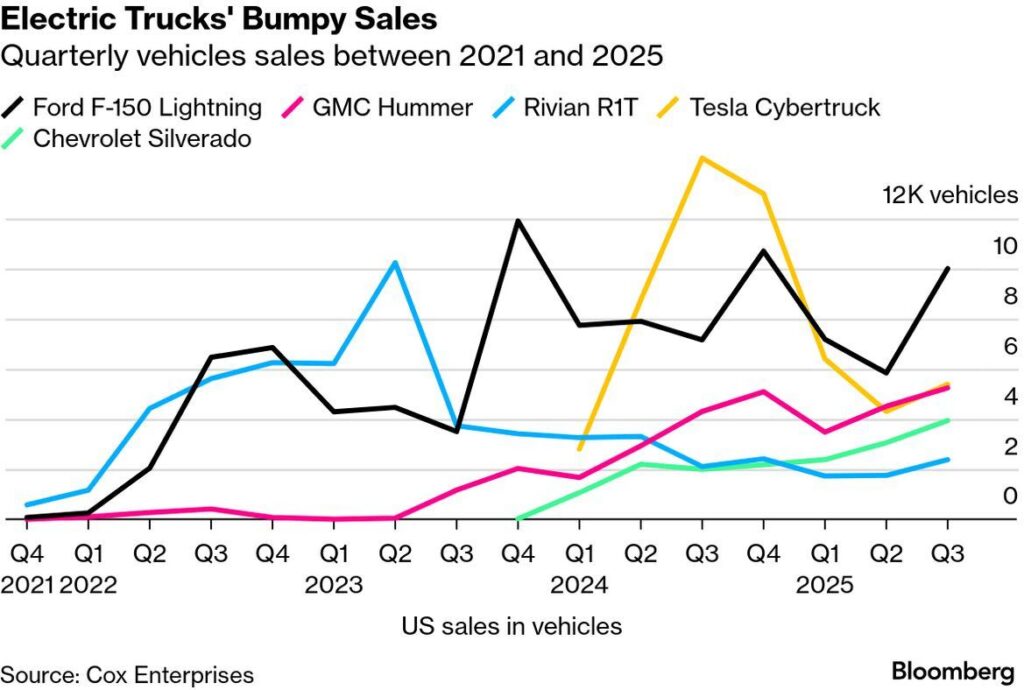
Sales of the electric F-150 did not collapse after an initial surge, unlike some competing models. Through the first three quarters of the year, only six electric vehicles sold in higher volumes than the Lightning in the United States, according to Cox Automotive, and none of them were full-size trucks or SUVs. Even so, Ford is expected to sell fewer electric F-150s this year than it did in 2024.
One of the Lightning’s biggest challenges has been pricing. The model never fulfilled its promise of cost parity with gasoline-powered trucks. The $40,000 starting price advertised at launch was quickly withdrawn and replaced with a $55,000 figure—one that rarely appeared on dealer lots.
In its first year on the market, the average transaction price—the actual price paid by buyers—was about $77,000, falling only slightly to $72,000 this year, according to Edmunds.com. By comparison, gasoline-powered F-150s sold for an average of $11,000 to $17,000 less.
These persistently high prices reflect deeper struggles within Ford’s electric vehicle division, which posted losses of $5.1 billion last year. The company expects those losses to widen this year. Ford is not alone: other automakers have scaled back or canceled EV programs. General Motors recently took a $1.6 billion charge related to its EV operations, while Stellantis NV has scrapped plans for an electric Ram pickup.
The rollback of EV incentives under the Trump administration is expected to further complicate electric vehicle sales, alongside proposed cuts to fuel efficiency standards. Farley warned that such policy changes could shrink the U.S. EV market by as much as 50%.
Despite the setback, Farley emphasized that Ford is not abandoning electric vehicles altogether. Instead, the company plans to focus on lower-cost EV models that can compete with Chinese manufacturers. Ford is developing a new EV platform and has pledged to introduce an electric pickup priced around $30,000 without subsidies. Rivals such as General Motors have also reaffirmed their commitment to EV development.
Still, Monday’s announcement underscores the risks of a rapid EV transition. Ford plans to convert a factory currently under construction—originally intended to produce electric trucks—into a facility that will manufacture gasoline-powered vehicles instead.
Recommended Article
-
Climate Pressure Hits Banks
-
Trump Rattles Wind Industry
-
China breaks the Davos hush on climate
-
Trump’s latest blow to climate
-
Iran Protests Grow as Rial Plunges
-
EV Boom Slows as Subsidies Fade
-
‘Untouchable’ no longer
-
Blockbuster year
-
Another log on the fire
-
Hybrids pick up speed
-
It’s not all bad news
-
Under New Ownership
-
New front in the war on wind
-
Blown away
-
What the end of the F-150 means