
Hybrids pick up speed
As EV Sales Stall in the US, Hybrids Emerge as the Market’s New Sweet Spot
Like many car dealers across the US, Scott Kunes was caught off guard by the rapid rise of electric vehicles.
In the third quarter, EVs were selling “like ice cream on the beach,” he said. But after federal purchase incentives expired at the end of September, demand cooled sharply across the roughly 50 Midwest dealerships operated by his company, which sells about 20 brands ranging from Mitsubishi to Mercedes-Benz.
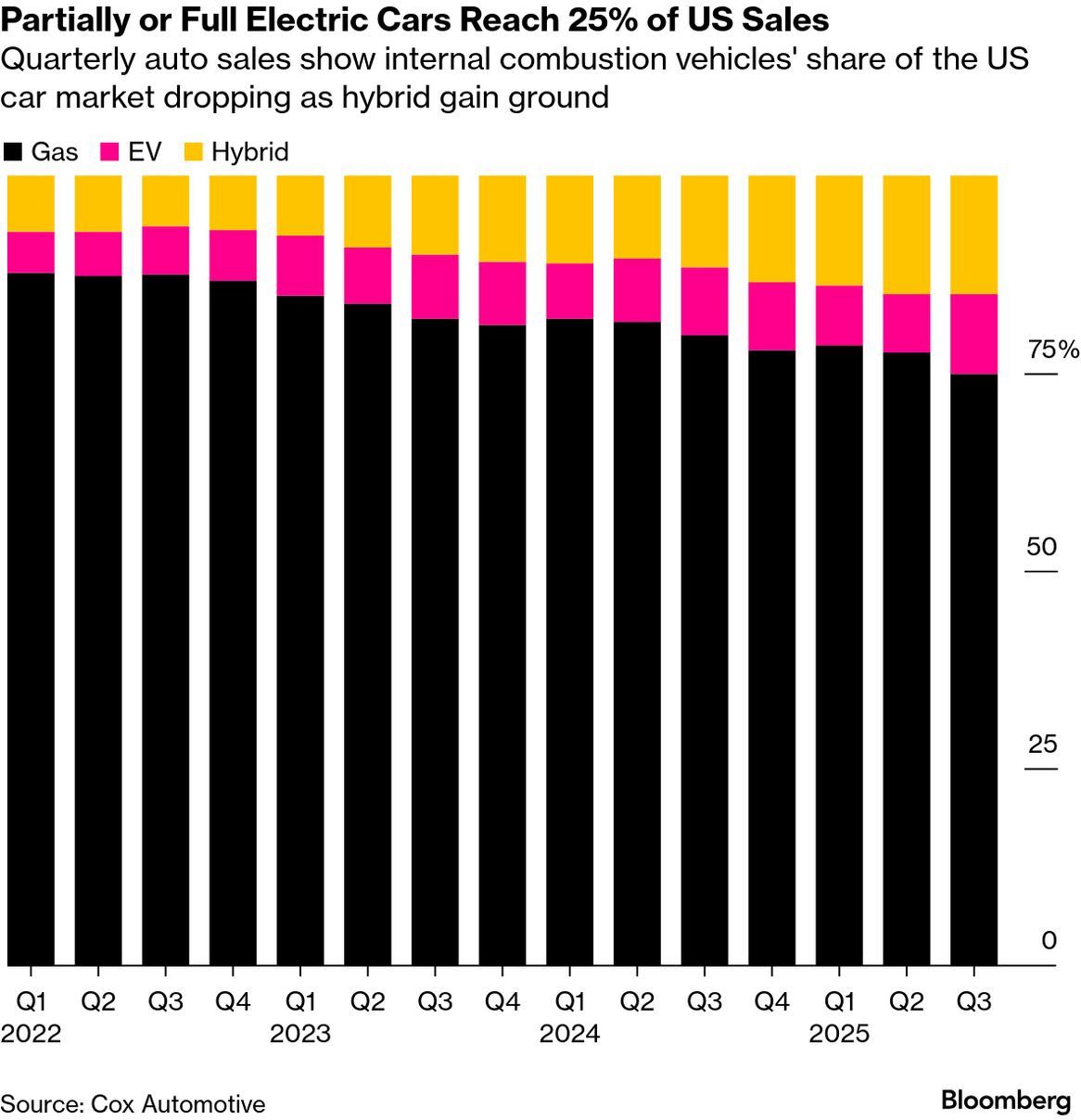
That slowdown didn’t translate into a return to gas-guzzlers. Instead, buyers pivoted toward hybrids — a shift playing out nationwide. While fully electric cars and trucks accounted for about 10% of total US auto sales in the third quarter, another 15% of transactions involved hybrid vehicles.
The US EV market is losing momentum, but analysts expect hybrid sales to keep climbing. CarGurus Inc., a digital listing platform covering most of the US auto market, forecasts that nearly one in six new vehicles sold next year will be a hybrid, as automakers greenlight more models using the technology. While hybrids still rely on gasoline, they are quietly reshaping emissions trends and smoothing the transition toward fully electric transportation.
With the Trump administration eliminating federal EV purchase incentives of up to $7,500, electric vehicle sales are expected to drop as much as 30% in the fourth quarter and remain largely flat through much of next year. Cost-conscious Americans increasingly view hybrids as a pragmatic way to cut fuel expenses and emissions without the higher upfront prices or charging concerns associated with EVs.
“They offer a bit of everything to consumers,” said Peter Nagle, associate director of demand forecasting for the Americas at S&P Global Mobility. Demand is likely to keep rising, he added, with hybrids proving particularly appealing in rural areas and in Republican-leaning states.
CarGurus has dubbed hybrids the success story of 2025. The Hyundai Palisade Hybrid is the best-selling vehicle in the US this year, spending less than 14 days on average on dealer lots.
Of the roughly 390 vehicle models available in the US, about 87 now come with hybrid powertrains — nearly 50% more options than drivers had five years ago, according to Edmunds.com. Even as automakers struggle to make EVs profitable, analysts say investments in batteries and electric motors are paying off by improving hybrid offerings.
“We’ve invested heavily in EV and battery technology, and we need to find the best way to leverage it,” Kunes said. “There’s a strong case that hybrids could become the dominant powertrain in the market — and that shift could happen sooner than people expect.”
Ford Motor Co. this month said it would halt production of the all-electric F-150 Lightning and repurpose its assembly line to build a new long-range hybrid pickup, in part because of its substantial investment in battery capacity. By 2030, Ford expects half of its global sales to come from vehicles that are fully or partially electric.
Toyota Motor Corp. is already at that level, driven largely by strong demand for hybrid versions of the RAV4. Honda Motor Co. is moving in the same direction, anchoring its business around hybrids at least through 2030.
In the long run, hybrids may prove nearly as effective as federal incentives in nudging consumers toward fully electric vehicles. About one-third of hybrid owners switch to EVs when replacing their next car. In September, roughly 57% of car buyers said they were considering a fully electric vehicle, according to JD Power. Among hybrid households, that figure climbed to nearly 70%.
Recommended Article
-
Climate Pressure Hits Banks
-
Trump Rattles Wind Industry
-
China breaks the Davos hush on climate
-
Trump’s latest blow to climate
-
Iran Protests Grow as Rial Plunges
-
EV Boom Slows as Subsidies Fade
-
‘Untouchable’ no longer
-
Blockbuster year
-
Another log on the fire
-
Hybrids pick up speed
-
It’s not all bad news
-
Under New Ownership
-
New front in the war on wind
-
Blown away
-
What the end of the F-150 means