
EV Boom Slows as Subsidies Fade
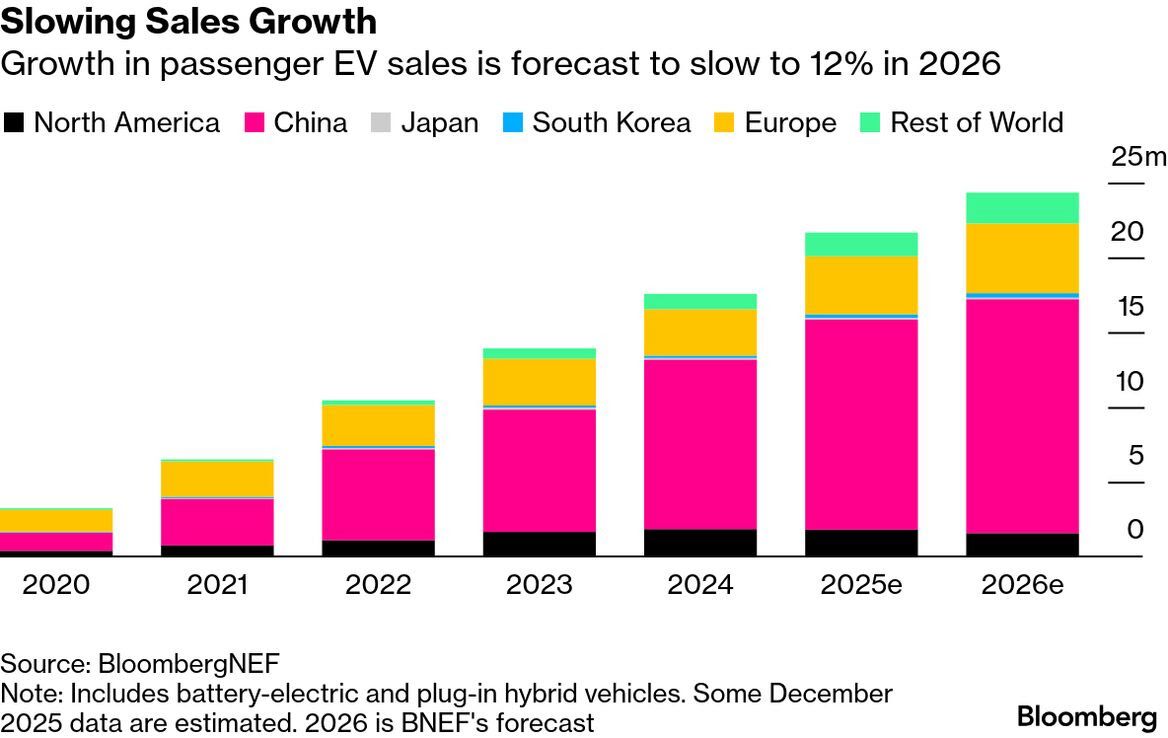
Global EV Sales Growth Set to Slow as Subsidies Fade and Policy Support Weakens
Global sales growth of electric vehicles is expected to slow this year as China scales back subsidies, Europe wavers on its internal combustion engine phaseout, and automakers and policymakers in the US retreat from the segment.
BloombergNEF estimates global passenger EV sales will reach 24.3 million units this year, an increase of just 12% from 2025, sharply down from the 23% growth recorded last year.
In the US, the electric-vehicle industry is facing what analysts describe as an “EV winter.” Manufacturers must endure a difficult period before a potential rebound in 2027 and 2028, said Nathan Niese, global lead for EVs and energy storage at Boston Consulting Group. While the long-term outlook for battery-powered vehicles remains positive, he said there is little in 2026 to materially lift market optimism.
Those challenges are underscored by Ford Motor Co.’s decision in December to take a $19.5 billion charge tied to a major overhaul of its EV business. The move includes plans to rework its flagship F-150 Lightning into an extended-range hybrid, marking one of several strategic reversals by major automakers outside China.
The US market has come under additional pressure after the Trump administration withdrew consumer tax credits of up to $7,500 at the end of September and loosened fuel-efficiency standards. BloombergNEF said US EV sales plunged 41% year-on-year in December.
Even in China, the world’s largest EV market, growth is expected to cool. Beijing has halved EV tax incentives for 2026 and tightened its “cash-for-clunkers” program. Authorities have also criticized what they describe as excessively aggressive price competition and moved to curb deep discounting used by manufacturers to sustain volumes.
“The Chinese government is clearly trying to ease the price war,” said Michael Dunne, CEO of consultancy Dunne Insights.
Intensifying competition has pushed BYD Co. to its weakest annual sales growth since 2020, as rivals such as Geely Automobile Holdings Ltd. and Xiaomi Corp. gain market share. Automakers are also encountering slower growth as they expand into smaller cities and rural areas.
Bloomberg Intelligence estimates passenger EV sales in China — including plug-in hybrids and extended-range hybrids — reached 15.6 million units in 2025, up 27% from the previous year. Growth in 2026 is projected to slow to 13%.
Despite the deterioration in policy support, the sector’s underlying economics are improving. Battery prices — the most expensive component of an EV — fell another 8% in 2025, according to BloombergNEF, helping to improve affordability.
“Automakers that can cut costs and offer affordable models in the most in-demand vehicle segments are likely to sustain sales growth,” said Huiling Zhou, an analyst at BloombergNEF.
Recommended Article
-
Climate Pressure Hits Banks
-
Trump Rattles Wind Industry
-
China breaks the Davos hush on climate
-
Trump’s latest blow to climate
-
Iran Protests Grow as Rial Plunges
-
EV Boom Slows as Subsidies Fade
-
‘Untouchable’ no longer
-
Blockbuster year
-
Another log on the fire
-
Hybrids pick up speed
-
It’s not all bad news
-
Under New Ownership
-
New front in the war on wind
-
Blown away
-
What the end of the F-150 means