
Under New Ownership
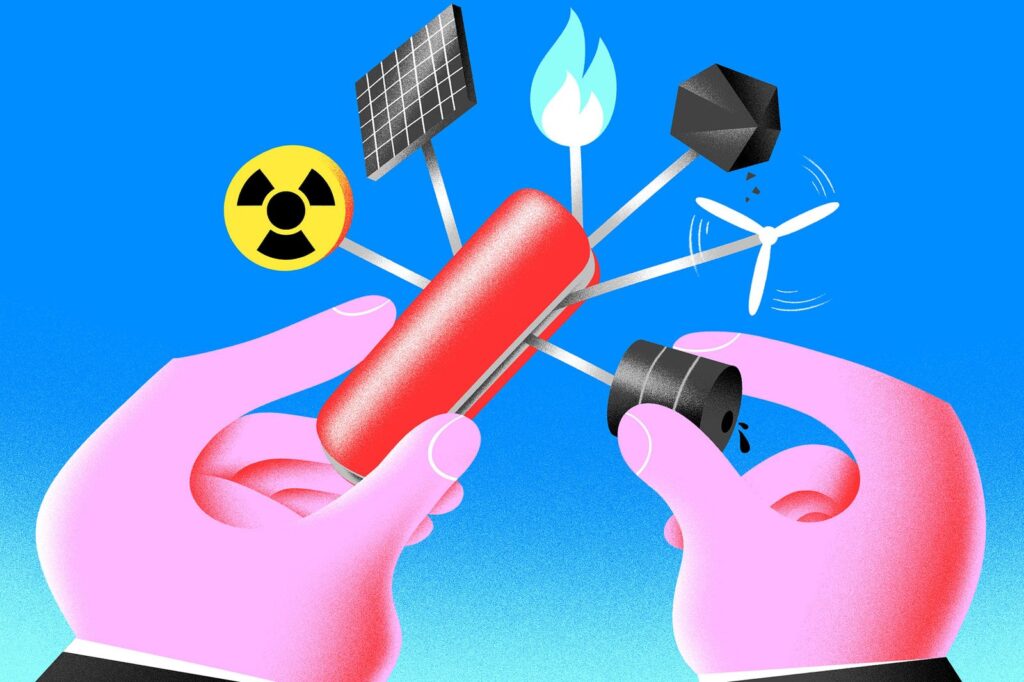
US Energy Politics Are Flipping as Democrats Embrace ‘All-of-the-Above’
The governor was furious. Federal funding had just been pulled from an energy project that could have become a multibillion-dollar hub supplying fuel for ships, trucks and buses in one of America’s most industrialized states.
“No matter what DC tries to dictate,” he snapped in response to the withdrawal of government support, “we’re going to keep pursuing an all-of-the-above strategy.”
Calls for inclusive energy policies like this one were common during President Joe Biden’s term, when Republicans and oil-industry allies routinely accused Democrats of restricting fossil fuels while subsidizing low-carbon technologies.
But the governor venting his anger earlier this year was California’s Gavin Newsom — a leading Democratic contender for the next presidential election and one of President Donald Trump’s most outspoken critics. Echoing arguments long used by Republicans, Newsom condemned Trump’s decision to withdraw funding from a West Coast clean-hydrogen hub as ideological and contrary to what he called “common sense.”
The episode underscores how US energy politics have shifted sharply in 2025. This week alone, the Trump administration suspended permits for all five offshore wind projects currently under construction along the East Coast. At the same time, Newsom — long regarded as a staunch clean-energy advocate — has spent recent months promoting higher oil production, easing fossil-fuel regulations and scrapping plans to cap refinery profits.
With electricity prices increasingly replacing gasoline prices as the dominant political flashpoint, several prominent Democrats are now moving quickly toward “all-of-the-above” energy policies just as Trump and his allies abandon that approach in favor of curbing renewable development.
Virginia Governor-elect Abigail Spanberger campaigned on an all-of-the-above platform in a state positioning itself as a hub for energy-hungry data centers. Pennsylvania Governor Josh Shapiro has branded himself an “all-of-the-above energy governor” while leading a politically pivotal swing state. New York Governor Kathy Hochul’s recent backing of natural gas, framed as part of a push for “reliable and clean” power, represents another textbook example of the strategy.
“There’s clearly political motivation behind this,” said Ben Cahill, director of energy markets and policy at the University of Texas at Austin. “Democrats recognize that affordability is going to be a major issue heading into the next election cycle.”
The scramble toward the political center on energy has been enabled by Trump’s aggressive efforts to halt wind and solar projects at a time when US electricity demand is projected to surge 35% by 2040, driven largely by the explosive growth of artificial intelligence data centers. Nationwide, electricity prices rose 5.1% in the 12 months through September 2025 and are expected to climb further as utilities upgrade grids to withstand more frequent extreme weather linked to climate change.
Trump’s campaign against renewable energy marks a sharp departure from more than two decades of Republican policy. Since the George W. Bush era, Republicans typically paired support for oil and gas with backing for wind and solar growth. That emphasis on energy abundance — rather than elimination — aligned with free-market principles and offered rhetorical cover for fossil-fuel interests in a world increasingly focused on climate change.
Trump has instead recast the party’s stance as one of selective preference, backing certain energy sources while actively opposing others. In January, he declared a national energy emergency to invoke sweeping, Cold War-era authorities to accelerate pipeline construction, expand the power grid and rescue struggling coal-fired plants, while continuing to urge oil producers to “drill, drill, drill.”
Those efforts are now increasingly intertwined with measures that directly hinder clean-energy development. And for the first time in years, it is the renewable-energy industry that finds itself on the defensive.
Recommended Article
-
Climate Pressure Hits Banks
-
Trump Rattles Wind Industry
-
China breaks the Davos hush on climate
-
Trump’s latest blow to climate
-
Iran Protests Grow as Rial Plunges
-
EV Boom Slows as Subsidies Fade
-
‘Untouchable’ no longer
-
Blockbuster year
-
Another log on the fire
-
Hybrids pick up speed
-
It’s not all bad news
-
Under New Ownership
-
New front in the war on wind
-
Blown away
-
What the end of the F-150 means