
Blockbuster year
Green Assets Attract Record Inflows as AI Fuels Global Power Demand
Investors are pouring money into climate-friendly assets this year, defying policy and regulatory rollbacks in the US and Europe, as artificial intelligence drives a surge in demand for energy infrastructure.
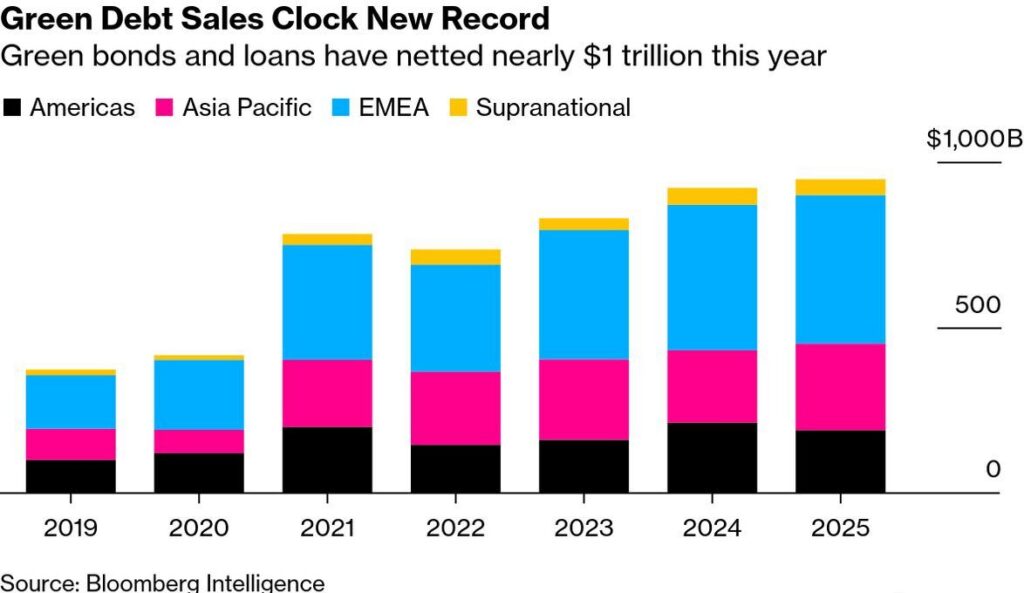
Global issuance of green bonds and loans has reached a record $947 billion so far this year, according to data compiled by Bloomberg Intelligence. The inflows come as renewable-energy stock indexes head for their first annual gains since 2020, outperforming the S&P 500 by a wide margin, while shares of power-grid and energy-infrastructure companies remain firmly in favor.
The resilience of green investment is striking given the political backdrop. US President Donald Trump has openly backed fossil fuels while dismantling clean-energy subsidies and climate legislation. In Europe, governments have softened some of the region’s most stringent environmental rules amid concerns over economic growth and competitiveness.
Despite those headwinds, investors are responding to clearer long-term policy signals and a structural rise in electricity demand. Global power consumption is expected to increase by nearly 4%, driven by AI data centers, rising cooling needs and broader electrification across industries.
“Green investments are increasingly viewed as core infrastructure and industrial opportunities rather than niche ESG trades,” said Melissa Cheok, associate director of ESG investment research at Sustainable Fitch. Capital is gravitating toward assets with “clear revenue visibility, policy support and structural demand,” including grid upgrades and renewables tied to electrification, she said.
Asia-Pacific has emerged as a major driver of issuance. Companies and government-linked entities in the region raised $261 billion through green debt, about 20% more than a year earlier, according to Bloomberg Intelligence. China led the surge with a record $138 billion in green bond sales, largely from its largest state-owned lenders, and launched its first sovereign green bond in London earlier this year. India has also stepped up support for renewable-energy deployment.
Borrowers are benefiting from the so-called greenium, the lower financing costs associated with green bonds. The pricing advantage is most pronounced in Asia-Pacific, where some issuers secured discounts of more than 14 basis points in November, according to BloombergNEF. Proceeds are typically used to fund renewable power, grid expansion and lower-carbon transportation.
BNP Paribas SA and Credit Agricole SA rank as the top global underwriters of green bonds this year, Bloomberg data show. Outstanding green bonds have expanded at a 30% compound annual growth rate over the past five years and now represent about 4.3% of total global bond issuance, according to LSE Group researchers.
Lower US interest rates and refinancing needs could further accelerate the market. Global green bond issuance may climb to as much as $1.6 trillion next year, said Crystal Geng, ESG research lead for Asia at BNP Paribas Asset Management.
Equity markets are reflecting the shift. Clean-energy indexes tracked by S&P Dow Jones Indices and WilderShares have surged 45% and 60% this year, respectively, though both remain below their peaks reached in 2021.
Recommended Article
-
Climate Pressure Hits Banks
-
Trump Rattles Wind Industry
-
China breaks the Davos hush on climate
-
Trump’s latest blow to climate
-
Iran Protests Grow as Rial Plunges
-
EV Boom Slows as Subsidies Fade
-
‘Untouchable’ no longer
-
Blockbuster year
-
Another log on the fire
-
Hybrids pick up speed
-
It’s not all bad news
-
Under New Ownership
-
New front in the war on wind
-
Blown away
-
What the end of the F-150 means