
walking away from coal
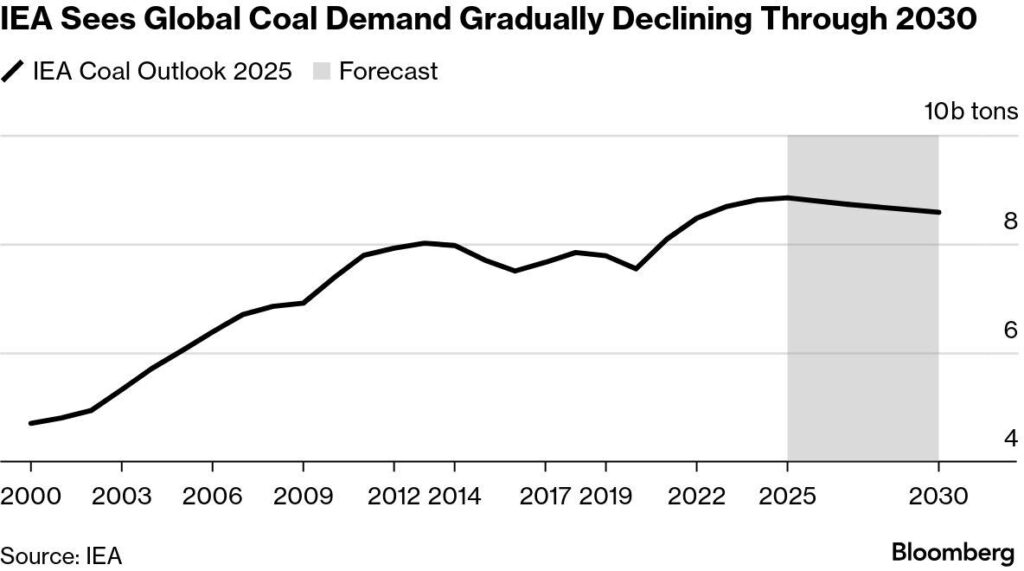
Global Coal Use Reaches Plateau, IEA Predicts Gradual Decline
The International Energy Agency (IEA) has stated that global coal consumption has reached its peak and is expected to begin a gradual decline over the next five years, driven by the rapid expansion of renewable energy and increased use of liquefied natural gas (LNG).
According to the IEA’s annual coal report published today, global coal demand is projected to rise slightly by 0.5% this year, reaching a record 8,845 million tonnes, before falling by around 3% by 2030.
“We expect global coal demand to level off before edging down slightly by the end of the decade,” said Keisuke Sadamori, IEA Director of Energy Markets and Security. “However, there are still many uncertainties affecting the outlook for coal.”
Coal remains the most polluting fossil fuel and is the world’s largest source of carbon dioxide emissions. Its continued use accelerates climate change, prompting countries such as the United Kingdom, France, and Spain to phase out or completely abandon coal-fired power generation. Despite this, coal continues to serve as a backbone of electricity generation in many parts of the world, with China alone consuming more coal than the rest of the world combined.
The IEA noted that coal consumption has reached a “saturation point” as renewable energy deployment accelerates. According to energy think tank Ember, solar and wind power are expanding fast enough to meet all new global electricity demand. Ember analysts estimate that renewables including solar, wind, hydropower, and smaller sources such as geothermal will generate more electricity than coal for the first time in 2025.
For years, analysts have struggled to pinpoint when coal consumption would peak, particularly as demand remains strong in China and India, even while advanced economies shut down coal mines and expand solar and wind capacity. The IEA cautioned that its five-year outlook is subject to “significant uncertainty that could materially affect projections.”
Much of this uncertainty centers on China, which accounts for more than half of global coal consumption and production. The IEA forecasts a slight decline in Chinese coal demand over the next five years. However, it warned that slower renewable deployment or accelerated coal-to-gas conversion projects could turn this modest decline into a slight increase.
These uncertainties reflect China’s evolving approach to climate-related pollution. There are indications that the country’s overall emissions have already peaked, and under the upcoming Five-Year Plan, the government aims to peak coal and oil use between 2026 and 2030. Nevertheless, subtle changes in recent official statements by the Communist Party suggest room for increased coal use toward the end of the decade.
In India, strong monsoon seasons have reduced electricity demand while boosting hydropower generation, the IEA said. As a result, coal-fired power generation is expected to decline this year compared with 2024, interrupting the growth seen in recent years.
Within the European Union, coal demand is expected to continue falling, but by only around 2% this year, compared with double-digit declines in 2023 and 2024. The slower decline reflects reduced hydropower and wind output, which led to higher coal-fired generation during the first half of the year.
In the United States, where coal demand has fallen by an average of 6% per year over the past 15 years, the trend is expected to reverse in 2025. The IEA projects an 8% increase in coal use, although U.S. authorities anticipate an even larger rise. Higher natural gas prices and slower-than-expected coal plant closures—supported by federal policy—are the main drivers behind this shift.
Even so, natural gas has overtaken coal to become the largest source of electricity generation in the U.S. this year, according to researchers at the World Resources Institute.
Despite policy support in the U.S., persistently low prices in international markets continue to weaken the economics of coal mining, the IEA noted. Coal prices have stabilized after surging during the COVID-19 pandemic and the early years of Russia’s invasion of Ukraine. Mining margins are shrinking as prices move closer to production costs. This trend is expected to continue through 2030, as higher emissions costs further erode coal’s competitiveness relative to natural gas.
Recommended Article
-
Climate Pressure Hits Banks
-
Trump Rattles Wind Industry
-
China breaks the Davos hush on climate
-
Trump’s latest blow to climate
-
Iran Protests Grow as Rial Plunges
-
EV Boom Slows as Subsidies Fade
-
‘Untouchable’ no longer
-
Blockbuster year
-
Another log on the fire
-
Hybrids pick up speed
-
It’s not all bad news
-
Under New Ownership
-
New front in the war on wind
-
Blown away
-
What the end of the F-150 means